
Ylang Ylang
The Wild One
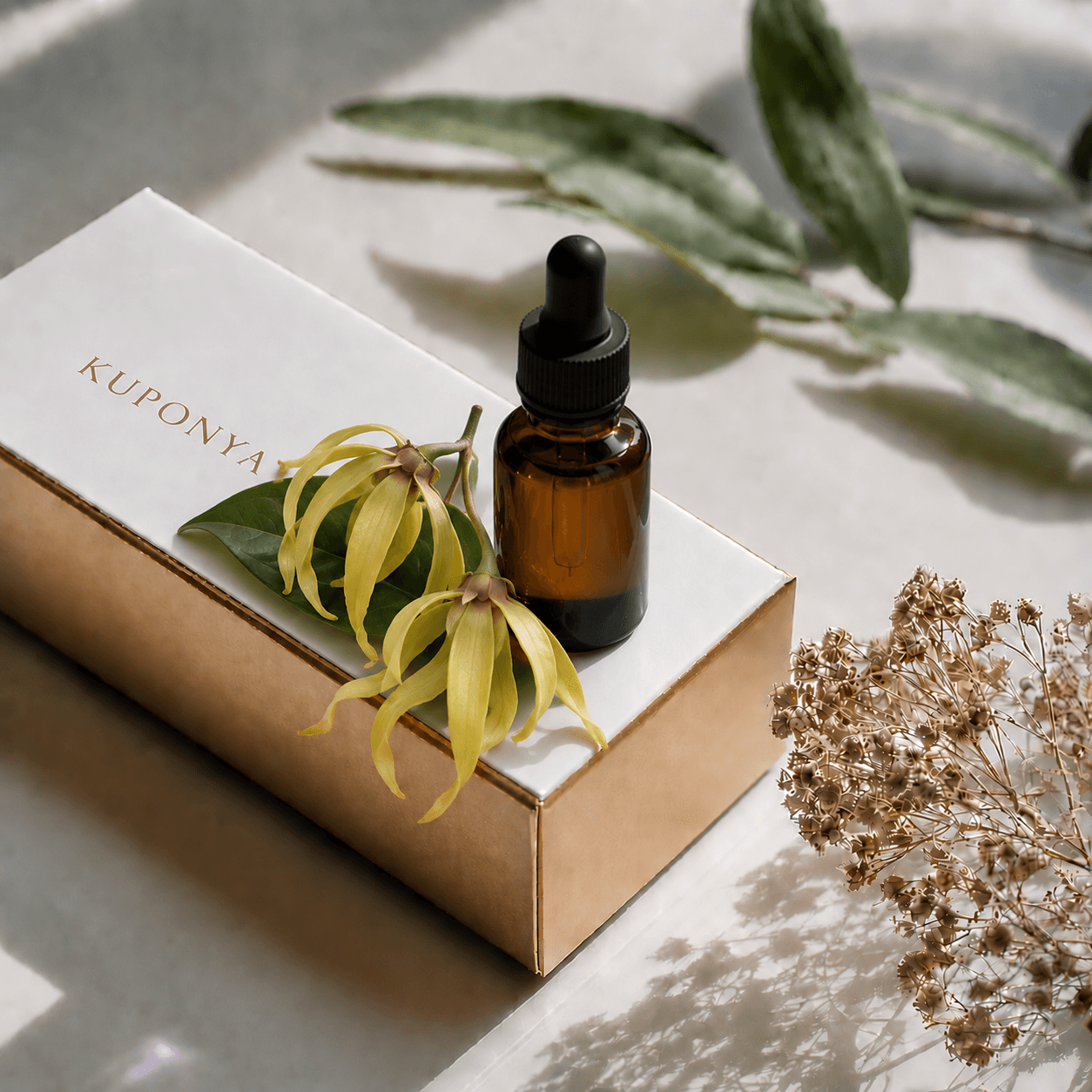
Before it was a perfume, it was a wedding. In Indonesia, the yellow petals of this flower are strewn across the bed on the wedding night; in Java and Bali they go into ceremonies mixed with jasmine and champaca and rose; women tuck a single blossom into their hair. In the Philippines the tree is ilang-ilang, and the name is a Tagalog word doubled: ilang means wilderness, the wild, uncultivated ground where the tree grows on its own. The world knows it as "the flower of flowers." That is not what the word means; it is what the trade made of it, a translation made for the trade, not for Manila. It is a Philippine and Indonesian tree first, native to the islands from the Philippines and Sulawesi across Java, Sumatra, and Borneo to New Guinea, and its scent was the smell of celebration across Southeast Asia long before it had a French name.
The scent itself is the reason for everything that follows. It opens sweet and heavy, banana and custard and jasmine at once, so dense it is almost narcotic, and under the sweetness there is something green and a little medicinal that keeps it from cloying. It does not drift; it settles on you. One breath and the room is different.
Then France took it west. In 1770, a tree was carried from the Philippines to Réunion; around 1909, it was planted in Madagascar, and a few years later in the Comoros and Mayotte, on plantations laid over the islands' best land. Today, the Comoros, four small islands between Madagascar and Mozambique, produce around 70% of the Ylang Ylang oil on earth, nearly all of it exported to France, picked by hand at dawn by women who receive about a third of what the flowers sell for, and distilled over wood fires that have taken most of the islands' forests. Coco Chanel put it at the heart of No. 5 in 1921. The wild flower of the Philippines became the scent of Paris through the hands of Comorian women, and almost nobody who wears it knows the islands' name.
This is the oil I pair with the Tender Stone, and it does the thing the stone cannot: it works on the body. Rose Quartz permits you to be gentle with yourself. Ylang Ylang is the exhale.
Quick reference
- Also known as
- Ilang-ilang, alang-ilang (Philippines; from ilang, wilderness) · kenanga (Java) · kananga (Indonesia) · "the flower of flowers," the trade's name
- Plant
- Cananga odorata (Lam.) Hook.f. & Thomson, forma genuina · family Annonaceae · a tall tropical tree with drooping yellow flowers
- Related
- Cananga oil, from forma macrophylla, distilled whole in Indonesia; a coarser cousin of the same tree
- Key sources
- The Comoros (Anjouan above all) · Madagascar (Nosy Be, Ambanja) · Mayotte · native to the Philippines and Indonesia, where commercial production began
- Extraction
- Steam distillation of fresh flowers, picked at dawn, in a 20- to 24-hour run that yields graded fractions: Extra, First, Second, Third, or the whole run bottled as Complete
- Notes
- Top: sweet, heady, banana-custard, jasmine-like · Heart: creamy, fruity-floral, a little spice (the Comorian oil is spicier than the Malagasy) · Base: soft, balsamic, faintly green and medicinal
- Tradition
- Celebration · the wedding bed · the loosened body
- Safety
- One of the most skin-reactive essential oils: dilute low (0.5 to 1% on skin), patch-test, never daily on the same skin for long stretches · listed as safe in pregnancy by the IFPA and NAHA; Elizabeth Ashley avoids it before 37 weeks · not on children under 2 · relaxes, so it can lower blood pressure · keep away from eyes
- KUPONYA pairing
- Rose Quartz
Two ways to begin
The exhale. 1 drop in the diffuser at the end of the day, and then do the thing you have not been doing all day: let your jaw go. Let the shoulders drop. Breathe out longer than you breathe in, 3 times. The scent is sweet enough that the body believes it.
The Soft Landing, with the stone. Rose Quartz in your palm, hand on your chest, the oil in the room. 3 slow breaths. That is the whole ritual, and it is the pairing this Library was built for: the stone gives permission, the oil does the unclenching.
A note on safety: Ylang Ylang is a known skin sensitizer, among the most reactive of all essential oils. On skin, dilute to 1% or less, patch-test first, and do not use it daily on the same skin. Full safety information is below.
The plant
Cananga odorata is a fast-growing tropical tree of the Annonaceae, the custard-apple family, with long drooping flowers that open green and take about 20 days to turn yellow. That is when they are picked: yellow, with a small red heart at the center, when the oil in the petals is at its peak. The flowers carry only about 2% oil by weight, and they make it at night and lose it in daylight, so picking starts at dawn and stops by mid-morning. Every picker in the Comoros and Madagascar knows this without a chemistry degree: the sun takes the scent.
In the wild, the tree grows tall; on plantations, it is bent and pruned low so women can reach the flowers, and a mature pruned tree gives a few kilos of blossom a year. It takes four to five kilos of fresh flowers to make one hundred milliliters of oil across all grades. Your ten-milliliter bottle is roughly half a kilo of flowers picked by hand before breakfast.
How the oil is made
Steam distillation, but with a twist that no other oil in this Library has. The flowers go into the still fresh that morning, and the run lasts 20 to 24 hours. The oil is not collected as a single batch. It is drawn off in successive fractions as the distillation goes on, and each fraction is a different oil. The first two hours give the Extra, the lightest, sweetest, most volatile fraction, rich in esters and linalool, the fraction fine perfumery pays for. Then the First, then the Second, and finally, hours later, the Third: heavier, greener, full of sesquiterpenes, the fraction that goes into soap. The International Organization for Standardization has defined those four grades since 1983, by density and ester value, for oil from Madagascar, the Comoros, and Mayotte. Bottle the whole run together instead of splitting it, and you have what the trade calls Complete, or in French, totum, which is the grade aromatherapy generally prefers because it carries the flower's whole chemistry rather than its top note.
The chemistry is why the scent behaves the way it does. Linalool, the same molecule that makes lavender lavender, carries the highest odor activity in the oil; benzyl acetate and geranyl acetate give the fruity-floral body; a dense crowd of sesquiterpenes, caryophyllene, germacrene, farnesene, make up as much as 40% and give the weight. Comorian oil tends to run spicier than Malagasy, a difference chemists have traced to vanillin, methyl eugenol, and cinnamyl acetate: same tree, different islands, different oil.
And the fire. A traditional still holds a couple of hundred liters and burns three to four cubic meters of wood per run. 24 hours of flame, per batch, every day of the harvest, across thousands of stills. That's what everything else turns on.
What it's really for
Each oil in this Library has a direction. Frankincense slows the breath, Myrrh holds, Juniper clears, Rose Geranium steadies what shakes underneath. Ylang Ylang loosens. It is the oil for the body that has forgotten how to stop bracing: the jaw that clenches while you read, the shoulders that live at your ears, the breath you have been taking in without letting all the way out. It is sweet, almost too sweet, and that is the mechanism of it, because a scent that heavy does not let you stay tense while you are inside it. It is the exhale, bottled.
This oil has an older register that studies do not measure, and the wedding bed knows it. The clinical aromatherapist Elizabeth Ashley teaches that Ylang Ylang is the oil of the sacral center, the place 2 fingers below the navel. Her practice is simple: a drop diluted in a teaspoon of sesame oil, held there with the flat of the hand, a slow breath out, and a question to sit with. Not what is happening out there, but what do I want, and what guilt sits around the wanting. Her line for the oil is the one I keep: you are balanced, you are sensuous, and it is fine.
Ashley's other rule for it is the one every new bottle teaches: a little goes a long way. Diffuse it at the far end of the room and let it waft and entice; on skin, less than 1%. She calls it a lesson in less is more, and it is. Trust me.
What the studies actually say
Since this is the oil most often sold as relaxing, here is the record, plainly. A 2004 study of 24 healthy volunteers found that inhaling Ylang Ylang lowered blood pressure and pulse while raising subjective alertness, and its authors traced the effect mainly to the subjective experience of the scent.
The largest study is a 2008 British trial of 144 volunteers, and it is the honest one: Ylang Ylang impaired memory and slowed processing, lowered alertness, and raised calmness. In plain words, it is not an oil for the desk, and the science as well as tradition has warned the reader who wears it to a meeting.
A 2013 Korean study of 29 men found that blood pressure fell in the group who sat in a diffused room, not in the group who didn't. Three Korean nursing studies on people with high blood pressure used blends, Ylang Ylang mixed with lavender and lemon or bergamot or marjoram, with mixed results: some found systolic pressure and stress fell; one found no difference in blood pressure at all. That is the whole peer-reviewed human record worth naming: small studies, short weeks, and blends that can't tell you which oil did what. It is enough to say the scent does something to bodies at rest. It is not enough to say more, so I won't.
Free sign-up unlocks the rest of the story.
Free sign-up unlocks the rest: the full use menu, safety, the Rose Quartz pairing, and how I use it.