
Rose Quartz
The Tender Stone
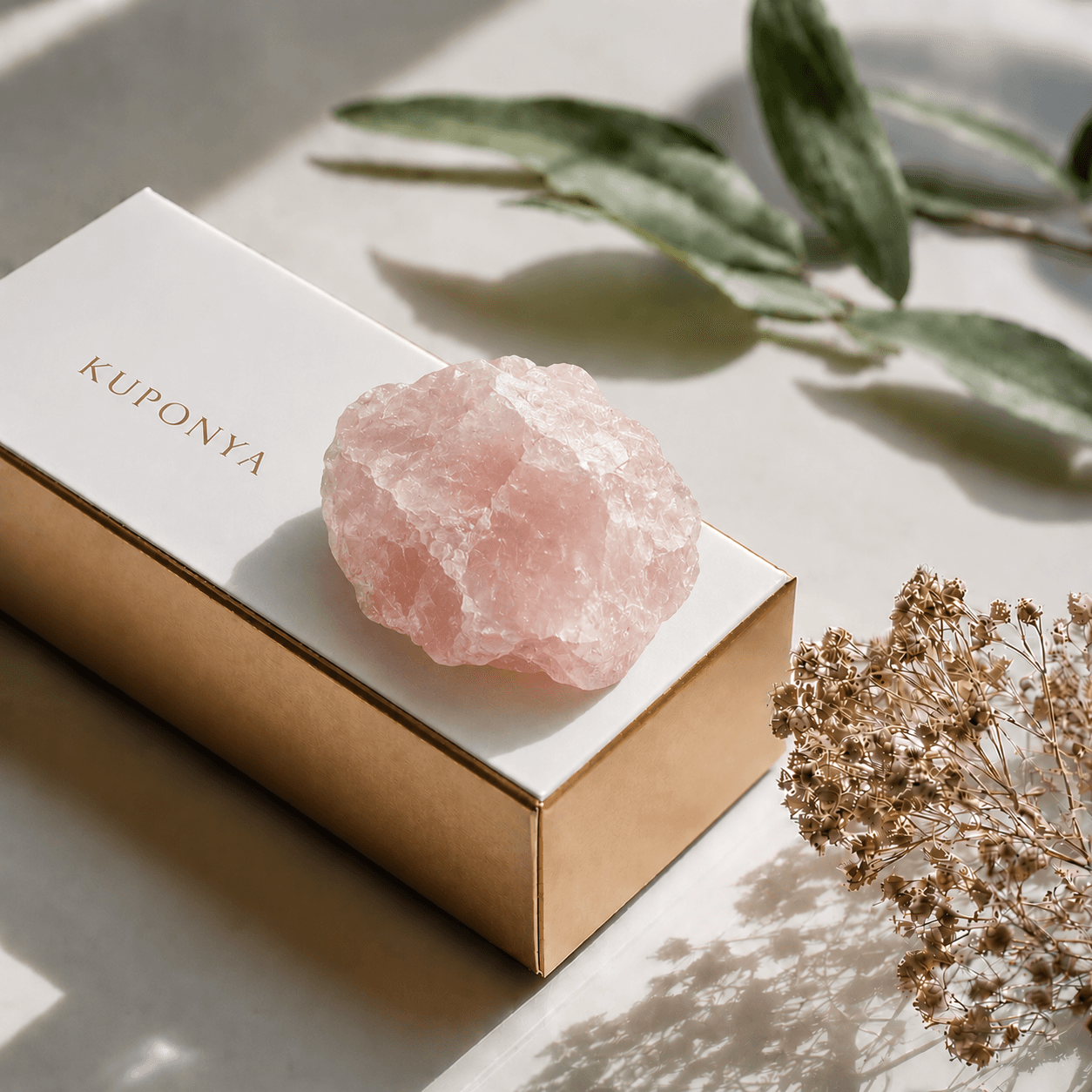
Hold a piece of Rose Quartz up to the light, and you will see it doesn't let light pass straight through. It glows instead. That haze is the whole secret of the stone: the pink is not the quartz at all. It comes from fibers so small they were first seen in 1987 and only explained in 2001: a mineral so close to dumortierite that it does not quite match it, threaded through clear quartz by the millions, one mineral carried inside another, coloring it from within. The Tender Stone is, quite literally, something held.
You will read everywhere that the Assyrians wore Rose Quartz, that the Egyptians prized it, and that beads of it were dug from Mesopotamia nine thousand years ago. I went looking for the excavation. It is not there. What survives a sourcing check is quieter and, to me, better: the oldest Rose Quartz objects I could find with a museum number are Chinese, carved in the 18th century under the Qing dynasty, a vase and a snuff bottle now in New York and Princeton. The stone's story is not an ancient one. It is the story of the ground it comes from, mostly the global South, and of the people who dig it and see little of what it sells for.
Its job is gentleness, and gentleness has a harder history than anyone selling it will tell you.
Quick reference
- Also known as
- Pink quartz (the rare crystal form) · "Bohemian ruby," the old trade's name
- Mineral
- Quartz, silicon dioxide, colored by fibrous nano-inclusions of a dumortierite-related borosilicate · Mohs 7
- Family
- Massive rose quartz (the cloudy, common kind) · euhedral pink quartz (rare true crystals, light-sensitive)
- Key sources
- Madagascar · Brazil (Minas Gerais, the Jequitinhonha Valley) · South Africa · India · Namibia · Mozambique · Sri Lanka · historically the Black Hills of South Dakota, USA
- Tradition
- The heart · tenderness · self-kindness · grief
- Care
- Warm soapy water and a soft cloth · hard enough to wear daily · keep the rare crystal kind out of strong light
- Best known for
- Love in all its forms, and the gentler one that is hardest: toward yourself
- KUPONYA pairing
- Ylang Ylang
Two ways to begin
The Soft Landing. At the end of the day, before you speak to anyone, sit down with the stone in your palm and let your hand rest against your chest. Three slow breaths. You are not asking it to fix the day. You are marking that the day is over and you are still here.
The hard word. When you catch yourself saying something to yourself that you would never say to a friend, pick the stone up and say the version you would say to the friend. Out loud if you can. The stone does nothing here except make you stop long enough to notice.
A note on care: Rose Quartz is hard and easy to look after; warm soapy water is fine. Full care is below.
The stone itself
Rose Quartz grows in pegmatites, the coarse veins in granite where minerals had room and time to grow large, and sometimes in hydrothermal veins. It rarely grows into a crystal with faces and a point. It comes out of the ground as massive, cloudy pink rock, and every pink chunk you have ever held is that massive kind. At Mohs 7, it is as hard as any quartz, which is why it can be carved, worn, and dropped in a handbag for years.
The color took two centuries to explain. The first English description, in 1794, blamed manganese; a 1924 paper blamed it again; in 1987 two researchers found fibers of something like dumortierite in the quartz; and in 2001 a team at Caltech extracted the pink from rose quartz taken at 29 localities around the world, Brazil, Madagascar, Namibia, South Dakota among them, and found the same thing everywhere: microscopic fibers, aligned in the quartz, of a mineral so close to dumortierite that it did not quite match it. Dumortierite is a blue-violet mineral in its own right, made of boron, aluminum, and silica, that grows in the same kind of rock; the fibers are its near relative, not the mineral itself, and the Caltech team later nicknamed them "dididumortierite" for the doubled pattern in their structure. The pink itself comes from iron and titanium inside those fibers trading charge under light. So the color of the Tender Stone comes from one mineral held inside another, and the haze that makes it glow is millions of those fibers scattering light.
There is a second, rarer thing also called rose quartz: true pink crystals, transparent, with points. Their color comes from a different cause entirely: damage from natural radiation, and it fades. Leave one in sunlight and the pink can bleach out within hours. The cloudy kind you own does not do that; its fibers are stable. Gemologists increasingly say the two deserve different names, and I agree, so from here on Rose Quartz means the massive, cloudy, steady kind.
One honest note for buyers: some Rose Quartz from certain deposits does fade slowly in strong light. The first American mineralogy to describe the stone in 1822 already warned that its color was "said to be injured by exposure to light"; the Caltech team saw no fading in their own samples, and reports of faded stone come from Brazilian mine dumps. If yours lives on a sunny windowsill and seems paler than the day you bought it, that is why. Moving it is enough.
What it's really for
Some stones in this Library ask you to look, or to stand your ground, or to see clearly. Rose Quartz asks the thing high-functioning people find hardest: to be gentle with yourself for one minute without earning it first. It is the stone for the end of the day, the hard week, the voice in your head that speaks to you the way you would never speak to anyone else. It softens nothing out there. It softens how you treat yourself.
Free sign-up unlocks the rest of the story.
Free sign-up unlocks the rest: the full use menu, safety, the Rose Quartz pairing, and how I use it.